wellbore fluid loss Can Be Fun For Anyone
Wiki Article
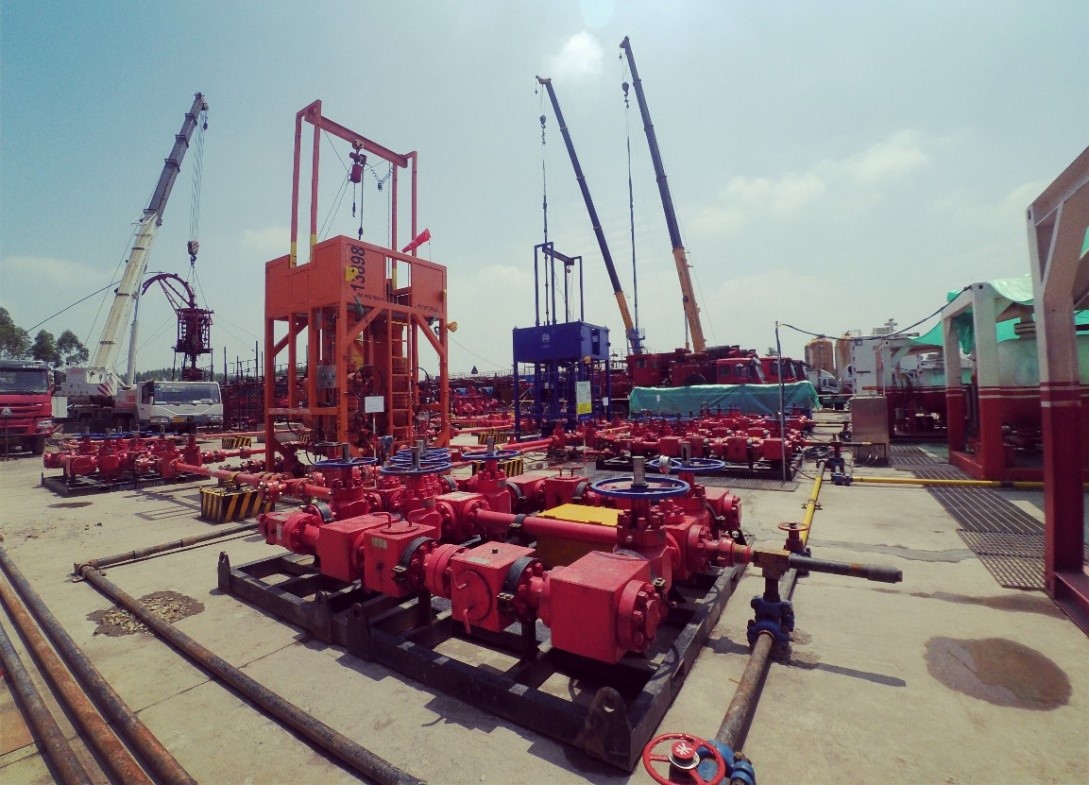
Loss takes place once the Operating fluid density is rather large for any minimal-force formation. The for a longer time the fracture extends, the more difficult it is actually to plug. Also, the more drilling fluid leaks, the tougher it is actually to plug. Fluid lost control need to consist of both of those prevention cure and plugging therapy.
may be the impact of compressible turbulent pulsation expansion on the overall dissipation price, W/m3; and μ t
I comply with get information on products and solutions, solutions, along with other internet marketing content from SLB, And that i agree to the General Privateness Detect. Be sure to agree Using the conditions
is the velocity on the stable, m/s. As the amount portion suggests the proportion of space occupied by Each and every stage, the quantity portion of your liquid and stable ought to fulfill:
Consistent monitoring and detailed Assessment also Enjoy pivotal roles. By intently tracking very well tension and observing Just about every stage in the drilling process, groups can detect early warning signs of fluid loss, allowing for timely intervention and minimized impact on operations.
Among the evaluated styles, the AdaBoost approach demonstrated superior predictive overall performance. It obtained a test coefficient of perseverance (R2) of 0.828, over the tests dataset. Sensitivity analyses uncovered that mud viscosity and solid information inversely have an impact on mud loss, whilst gap sizing and differential strain constantly result in its increase. These benefits ensure the efficacy of AdaBoost for very precise mud loss prediction. This work distinguishes alone by giving an extensive comparison of many State-of-the-art ensemble ML approaches on a large, true-world dataset from an Lively oil industry. The conclusions give a additional trustworthy and sturdy Instrument for forecasting mud loss, thus enhancing operational efficiency and risk mitigation in drilling operations. This contributes to optimizing drilling conclusions outside of the abilities of standard analytical solutions by giving information-pushed, actionable insights.
In Figure 19, the connection in between the loss rate and time of fractures with different widths, heights, and lengths is proven. As talked about before, the overbalanced strain is the biggest in the intervening time once the drilling fluid loss takes place, so in all simulation results, the instantaneous loss fee of drilling fluid is reached at The 1st time stage (i.e., t = 0.01 s). Because the loss time of drilling fluid extends, the overbalanced force decreases with the increase in fluid tension within the fracture, as well as the loss fee of drilling fluid decreases appropriately. In the event the fluid strain within the fracture continues to be unchanged, the force big difference at the two finishes from the fracture will remain consistent, and also the loss fee of drilling fluid will stabilize. Determined by the loss curve, it are available which the time needed for fractures with various geometric parameters to achieve steady loss differs, and the time necessary for fractures with diverse geometric parameters to reach stable loss is shown in Determine twenty. Within this paper, time needed to attain stable loss is equivalent to enough time expected for drilling fluid to invade into the fracture outlet, so this time displays the velocity of drilling fluid invasion during the fracture.
Other drill string mechanical machines like a mud motor or MWD tools. If your additive(s) is not going to go with the drill string, they can't be used.
Drilling fluid loss is a standard and complex downhole dilemma that occurs during drilling in deep fractured formations, which has a big adverse effect on the exploration and development of oil and gas assets. Creating a drilling fluid loss model to the quantitative Evaluation of drilling fluid loss is the best approach for that prognosis of drilling fluid loss, which offers a good foundation for your formulation of drilling fluid loss control steps, together with the knowledge on thief zone site, loss type, and the dimensions of loss channels. The prior loss design assumes which the drilling fluid is pushed by constant move or pressure on the fracture inlet. Nonetheless, drilling fluid loss is a complex physical method from the coupled wellbore circulation technique. The lost drilling fluid is pushed by dynamic bottomhole force (BHP) over the drilling procedure.
The coincidence diploma on the drilling fluid lost control effectiveness is superior, plus the evaluation result's good
Third stage—the secure loss stage of drilling fluid: As demonstrated in Determine 8a, the return Vertechs movement of drilling fluid during the annulus progressively rises And eventually remains continual. In distinction, the curve of loss charge of drilling fluid step by step decreases until finally it is actually flat. At the moment, there is a continuing difference between the return movement from the annulus and also the drilling displacement, establishing a whole new dynamic equilibrium. The curve of the cumulative loss of drilling fluid rises linearly, so the whole volume of drilling fluid in the sector decreases at a relentless rate, as well as the liquid stage decreases uniformly. The tension response through the loss method corresponds into the alterations in circulation rate in all places. Determine 8b reveals the improvements in a variety of pressures as time passes through the total loss procedure. The tension curve while in the fracture rises slowly and steadily gets flat. This is because of the decrease in the invasion speed of drilling fluid inside the fracture and the increase in the general loss quantity. Once the drilling fluid flows out from the consistent fracture outlet, the amount of drilling fluid in the fracture isn't going to change, and also the pressure inside the fracture remains regular. The BHP and standpipe force curves also rise and then gradually turn out to be flat.
Drilling fluid loss refers back to the phenomenon that drilling fluid enters the formation as a result of fractures under the influence of overbalanced tension in drilling [1]. In the whole process of very well construction in In a natural way fractured formations, Recurrent loss of drilling fluid don't just consumes drilling fluid and a large amount of lost circulation materials, resulting in critical financial losses, but will also raises non-successful time, lengthens the cycle of well building, and seriously delays the exploration and growth system [2].
Additionally, the analysis method can realize the realistic analysis of on-internet site lost control, as well as the efficiency of indoor and on-site drilling fluid lost control is in higher arrangement with superior evaluation benefits. This method can effectively guidebook on-web site lost control analysis, including oil and fuel fractured reservoirs and EGS of deep scorching-dry rock.
. The success of those additives may be quantified utilizing the permeability reduction aspect (Rk) which happens to be calculated as: